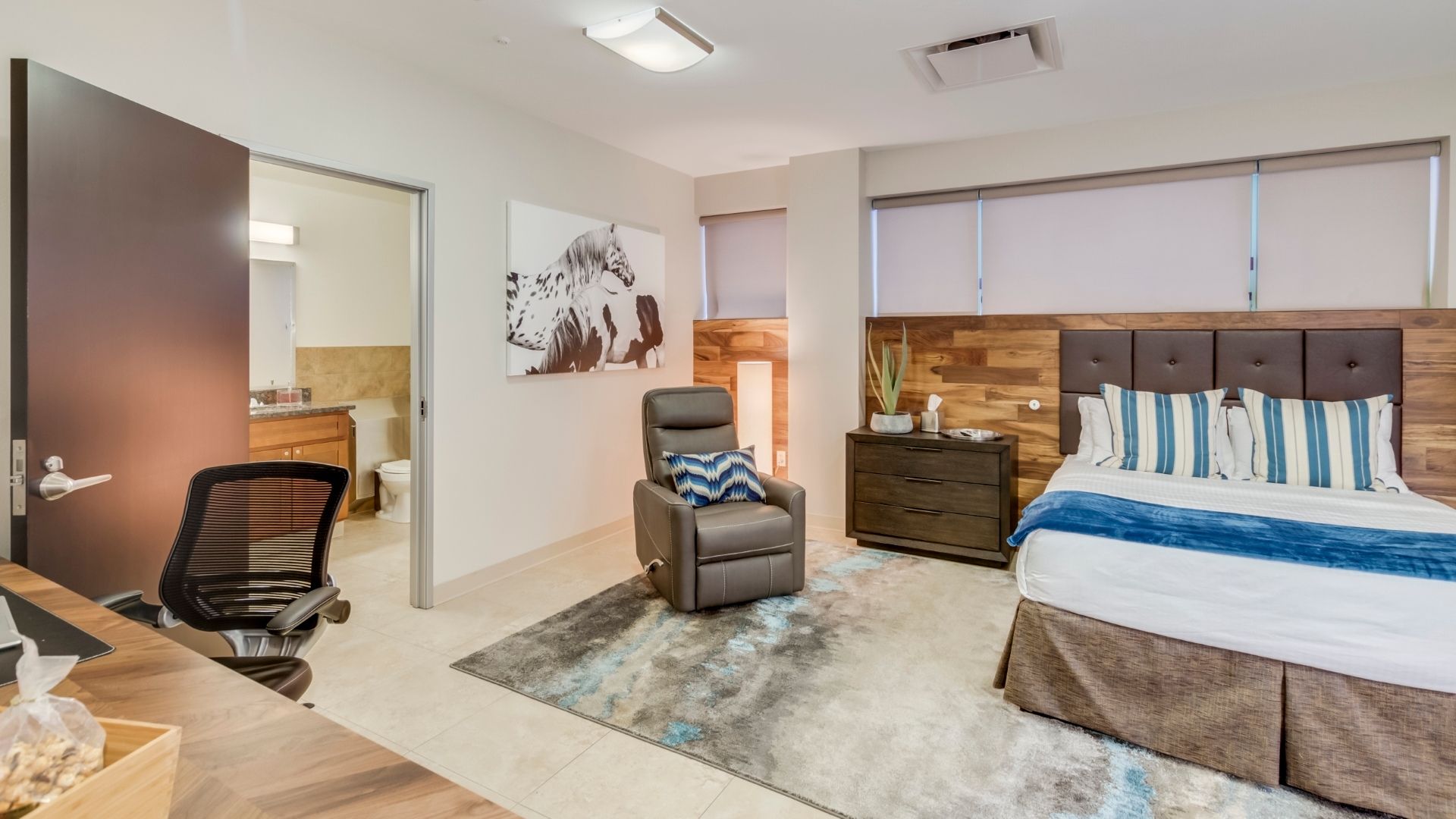
What Luxury Rehab Amenities Actually Look Like

Medical Providers:
Dr. Michael Vines, MD
Alex Spritzer, FNP, CARN-AP, PMHNP
Clinical Providers:
Natalie Foster, LPC-S, MS
Last Updated: August 14, 2026

Picture a treatment center that feels more like a wellness retreat than a hospital wing. Chef-prepared meals. A private room with a view. A therapy schedule built around you instead of a waiting list. That’s the world of luxury rehab, and it’s changing what people expect from addiction treatment.


Our Addiction Treatment Centers

Ready for comfort-driven recovery? Talk to our admissions team today.

What Amenities Do Luxury Rehab Centers Offer?

Ask ten people what a luxury amenities rehab facility should look like and you’ll probably get ten different answers. For some, it’s the gourmet meals prepared by an in-house chef. For others, it’s the acupuncture session after a morning yoga class. Most luxury rehab centers blend both worlds: resort-style comfort layered on top of serious clinical care.

A typical luxury rehab center offers a private room, spa-quality bathrooms, and grounds that feel closer to a boutique hotel than a hospital. Fitness centers, swimming pools, and equine therapy programs show up often too. Nutrition gets real attention here. Gourmet meals crafted by professional chefs aren’t just about taste; they’re part of rebuilding a body that substance use has worn down.

The amenities provided by luxury rehab centers go beyond physical comfort, though. Massage therapy, art studios, and meditation gardens give clients space to process emotions outside the therapy room. A handful of facilities even offer golf courses or oceanfront views, turning the setting itself into part of the healing process. None of this is indulgence for its own sake. It’s about clearing away distractions so a person can focus fully on getting better.

Technology has quietly worked its way in as well. Fitness trackers, sleep monitoring, and telehealth check-ins let clinical staff catch problems before they escalate. Sound baths and infrared saunas sit alongside more conventional exercise programs, giving clients several ways to manage stress instead of one prescribed routine.

Comfort supports the clinical work rather than competing with it. A person who’s sleeping better, eating real food, and moving their body daily walks into a therapy session with more to give. That’s part of why luxury rehabs put so much thought into the experience surrounding treatment, not just the sessions themselves.

How Does Luxury Rehab Compare to Traditional Rehabs?

The luxury rehab vs standard rehab question comes up a lot, and the honest answer depends on what someone needs. Traditional rehabs tend to prioritize function over comfort: shared rooms, cafeteria-style meals, group settings that can feel a bit impersonal. That model still works well for plenty of people, especially those on tighter budgets or with insurance plans that limit facility choice.

Luxury rehabs tend to keep client numbers lower. Smaller populations mean more one-on-one time with clinicians, faster access to specialists, and a treatment plan that adjusts to the person rather than forcing the person into the program. Staff-to-client ratios in luxury settings often run two or three times higher than at standard facilities.

Cost is the obvious tradeoff, and traditional rehabs cost less, sometimes dramatically so. But for people who’ve relapsed after a standard program, or who need privacy for professional or personal reasons, luxury rehab services can offer a level of discretion and individualized care that changes the outcome.

Not sure which path fits you? We'll walk you through your options.

What's the Value of a Private Room During Treatment?

Sharing a room during one of the hardest stretches of your life isn’t easy. A private room gives clients something easy to underestimate until you’re actually in it: quiet. Space to cry without an audience. Room to journal at 2 a.m. without waking someone else up.

This matters clinically more than it sounds. Sleep quality affects mood regulation and how well the brain responds to behavioral therapies. Luxury rehab centers with private rooms and amenities built around rest tend to see clients settle into treatment faster, mostly because the environment stops working against recovery.

There’s the matter of dignity, too. Detox and early recovery can involve physical symptoms most people would rather not go through in front of strangers. A private room protects that dignity, and for many clients, that alone determines whether they engage in treatment or shut down.

Privacy extends past the bedroom. Executives, public figures, and people in small, tight-knit communities often hesitate to seek care because they’re worried about being recognized or talked about. Luxury rehab centers with private rooms and limited shared spaces give these clients a real path into treatment they might otherwise avoid. For some people, discretion isn’t a nice extra. It’s the reason they walk through the door at all.

Do Luxury Rehab Amenities Improve Treatment Outcomes?

Insurance companies and skeptics love asking this one, and it’s a fair question. Do nicer surroundings actually lead to better recovery, or is it marketing dressed up as clinical care?

The honest answer sits somewhere in the middle. Amenities alone don’t treat substance use disorders. What treats them is a solid combination of evidence-based therapies, behavioral therapies, and, when needed, dual diagnosis care for co-occurring mental health conditions. A beautiful facility with weak clinical programming won’t outperform a modest one with strong treatment protocols. It just won’t.

Still, environment shapes engagement. Clients who feel physically comfortable and emotionally safe tend to open up faster in therapy. A holistic approach that pairs evidence-based treatment with stress-reducing extras like yoga, nutrition work, and massage often produces stronger buy-in than clinical treatment on its own. Think of the amenities as the container rather than the content. They don’t replace the treatment plan. They make it easier for someone to actually stick with one.

Support groups still play a central role in luxury settings. Peer connection doesn’t disappear just because the furniture is nicer.

Comfort plus real clinical care. See what that combination looks like.

Does Insurance Cover Luxury Rehab Services?

Insurance coverage for luxury rehab varies quite a bit, so it’s worth checking rather than assuming either way. Most plans will cover the clinical components of treatment, things like detox, therapy sessions, and medication management, no matter which facility provides them. What plans typically won’t cover is the premium for private rooms, gourmet meals, or spa services.

Some luxury drug and alcohol treatment centers work directly with insurance providers to cover a portion of the stay, with clients paying the difference for upgraded amenities. Others run on a private-pay model entirely, which simplifies billing but requires more planning upfront.

Call your insurance provider directly and ask what’s covered under your specific plan. Many treatment facilities have admissions staff who will verify benefits for you before you commit to anything, which takes a fair amount of guesswork out of the financial side.

Try asking specific questions instead of general ones. “Is detox covered?” gets a different answer than “is my entire stay covered?” Find out whether inpatient care is included, how many days are authorized, and whether behavioral therapies and follow-up support groups fall under the same benefit. Some plans also draw a line between in-network and out-of-network luxury drug and alcohol facilities, and that distinction can swing your out-of-pocket costs quite a bit. A little homework early on saves real headaches later.

How Do You Choose the Right Luxury Rehab Center?

Location matters more than most people expect going in. Some clients want distance from home, a clean break from familiar triggers. Others prefer staying close to family for visits and eventual step-down care. Neither choice is wrong. It comes down to what will actually support your recovery.

Look closely at the clinical team, not just the property photos. Credentialed therapists, a strong staff-to-client ratio, and a real track record with substance use disorders and dual diagnosis cases should carry more weight than the pool or the chef’s résumé. Ask what evidence-based therapies they use and how the treatment plan changes as progress happens.

Tour the facility if you can, even virtually. Pay attention to how staff talk about clients. Ask about aftercare, and whether support groups continue once the residential program ends. Recovery doesn’t stop at discharge, and the centers worth choosing offer plans that carry people through the months after they leave.

Trust your gut, too: if a place feels right, not just impressive on paper, that instinct is usually worth listening to.

Let's find your right fit. Our team is ready to help.

Comfort and Clinical Care, Together

Luxury rehab amenities aren’t about excess. They’re about building an environment where someone can slow down, breathe, and do the hard work of healing without fighting their surroundings the whole time.

At Hart Rehab, we’ve built our treatment center around that balance: private rooms, thoughtfully prepared meals, and a calm setting, backed by evidence-based therapies and a clinical team that treats every treatment plan as its own. If you or someone you love is weighing options for addiction treatment, we’re here to answer questions and help you figure out what fits.

Your recovery can start today. Reach out to Hart Rehab now.