
Understanding the cost of rehab
When you start looking into financing rehab programs, it is easy to feel overwhelmed by numbers, acronyms, and fine print. Yet getting clear on costs is one of the most important steps in moving forward with treatment.
Rehab pricing can vary widely depending on the level of care, setting, and length of stay. Residential programs with private rooms, on‑site medical care, and specialized therapies often cost more than outpatient services, but they may also provide the structure and intensity you or your loved one needs.
At the same time, investing in substance use treatment typically pays off in significant ways. Research shows that every dollar spent on treatment saves about 4 dollars in healthcare costs and 7 dollars in law enforcement and criminal justice costs, for a total benefit of more than 7 to 1 compared to the original investment [1]. When you view rehab as both a health decision and a long‑term financial decision, the cost picture becomes more balanced.
If you would like a deeper overview of typical price ranges and payment structures, you can explore more on rehab cost and payment options. For now, it helps to break the financial side of treatment into three main pieces: what your insurance can cover, what programs and grants may be available, and what financing tools you can use for the remaining balance.
How rehab financing works
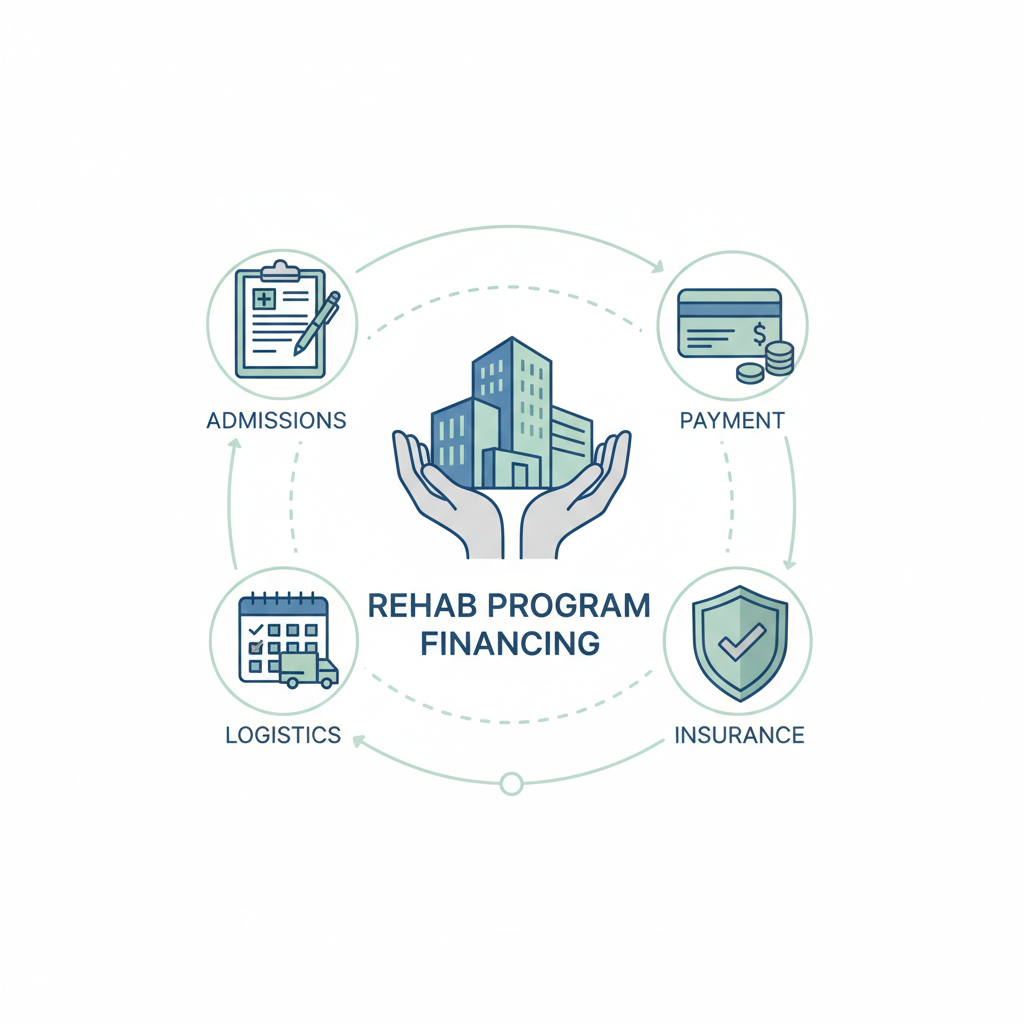
Financing rehab programs simply means using a combination of resources to pay for care over time instead of all at once. This usually involves three steps:
- Clarifying the actual cost of the program.
- Maximizing all available insurance and public benefits.
- Using financing tools such as loans, payment plans, or credit to cover any remaining amount.
Many people find that they are not responsible for the full “sticker price” they see online. Insurance often pays a large portion, and some facilities offer sliding scale fees based on income. Government programs and grants can also help bridge gaps, especially if you have lower income or limited coverage [1].
The goal is not to take on unnecessary debt, but to remove cost as a barrier to timely care. Waiting months or years to enter treatment because of finances can lead to higher medical bills, lost income, and legal problems later on. Evaluating your options early helps you choose a realistic and sustainable plan.
Using health insurance to pay for rehab
For many families, health insurance is the first and most important tool for financing rehab programs. Recent laws have expanded how much insurers must cover for mental health and substance use treatment.
Essential health benefits and parity
Under the Affordable Care Act, substance use disorder services are one of ten essential health benefits. Plans sold through ACA marketplaces and expanded Medicaid programs must cover services such as psychotherapy, counseling, inpatient mental health care, and substance use treatment, and they cannot deny you because of a pre‑existing condition like addiction [1].
The Mental Health Parity and Addiction Equity Act and the ACA also require insurers to cover mental health and substance use treatment on a level comparable to medical and surgical care [2]. This means that if your plan covers hospital stays and outpatient medical visits with certain copays or deductibles, it must treat qualified rehab services similarly.
Even with these protections, your plan may not pay for every facility or every level of care. That is why verifying benefits up front is essential.
Verifying insurance coverage
Before you make decisions about admission, you can confirm your benefits and likely out‑of‑pocket costs. Many treatment centers offer to check this for you. You can also work directly with your insurer.
To understand your benefits clearly, you may want to:
- Use a provider’s tool to verify insurance for treatment
- Review your plan’s summary of benefits for “behavioral health” or “substance use disorder” services
- Ask about preauthorization requirements for inpatient or residential rehab
- Confirm which facilities are in‑network
If you prefer a guided approach, visiting a page like insurance coverage for treatment can help you prepare the right questions and documents.
Insurance‑accepted rehab programs
Not every facility accepts every insurance plan. Programs that are “in‑network” with your plan have agreed rates, which usually translates to lower costs for you.
You may want to look specifically for an insurance accepted rehab to maximize your benefits. In‑network status can affect:
- Your deductible and out‑of‑pocket maximum
- Whether preauthorization is required
- How many days of residential care are covered
- Your share of coinsurance after meeting the deductible
If you are interested in a particular private rehab facility for its privacy, private rooms, or amenities, staff can help you understand how your insurance applies and whether any single case agreements are possible if the facility is out‑of‑network.
Government programs and public funding
If you have limited or no private insurance, there are still options to help with financing rehab programs. Public funding and state‑run grants support treatment access for many people each year.
Medicaid and state coverage
Medicaid is a primary source of substance use treatment coverage for people with low income. Many states have expanded Medicaid under the ACA, which requires that substance use and recovery services be included as covered benefits [1].
Coverage varies by state, but may include:
- Detox and medically managed withdrawal
- Inpatient or residential treatment
- Intensive outpatient programs
- Medication‑assisted treatment
- Counseling and aftercare
You can usually apply for Medicaid through your state health department or marketplace. Treatment centers that regularly work with Medicaid can often help you understand eligibility and next steps.
Federal and state block grants
The Substance Abuse Prevention and Treatment Block Grant, administered by SAMHSA, provides noncompetitive federal funding to states for substance use and mental health services. These funds often support publicly funded rehab centers and specialized services for populations such as pregnant and postpartum women [1].
In 2016, nearly 1.7 million people aged 12 and older were admitted to publicly funded rehab centers across the United States, with opiates, alcohol, and marijuana representing the primary substances treated [1]. This highlights how critical public funding is for making treatment accessible.
If you are interested in these options, a local community mental health center or county health department can typically guide you toward programs that receive block grant or state funding.
Specialized grants and corrections‑based programs
For individuals involved in the justice system, additional streams of funding and program support may be available. For example, in California, grants such as the Innovative Programming Grant, CARE Grant, Restorative Justice Grant, and Victim Impact Grant provide resources to nonprofit organizations that deliver restorative justice and rehabilitative programming in state institutions [3].
While these programs focus on incarcerated or formerly incarcerated individuals, they reflect a broader trend: public systems increasingly recognize the value of treatment and restorative approaches in reducing recidivism and improving outcomes.
Personal loans and credit options
Even after insurance and public funding are accounted for, you may still face a remaining balance. At that point, personal financing tools can help you move forward without delay.
Healthcare and personal loans
You can use different types of loans to spread rehab costs over time:
- Personal loans from a bank, credit union, or online lender
- Healthcare‑specific loans that are designed for medical expenses
- Specialized rehab or treatment financing through third‑party lenders
These loans can cover immediate needs such as medical detox, inpatient rehab, and outpatient services when insurance falls short [2]. When you compare options, you will want to look closely at:
- Interest rates and whether they are fixed or variable
- Repayment terms and monthly payment amounts
- Any origination fees or prepayment penalties
A loan can be a bridge that makes treatment possible now while you or your loved one work toward stability and long‑term recovery.
Support from family and friends
In some situations, a personal loan from family or friends can be the most flexible option. This type of support can reduce interest costs and create repayment terms that match your real financial situation.
Experts recommend using a written agreement, even when everyone has good intentions, to protect relationships and avoid misunderstandings [2]. You might outline:
- The total amount and purpose of the loan
- Payment schedule and amount
- Whether any interest will be charged
- What happens if payments are delayed
Approached thoughtfully, family support can be an important piece of financing rehab programs while also strengthening trust and communication.
Using credit cards cautiously
Credit cards and healthcare credit products can also be used to pay for treatment, especially if they offer low introductory rates or deferred interest. However, it is important to review the fine print before relying on this route.
Healthcare credit cards sometimes waive interest for an initial period, but if the full balance is not paid off by the end of that period, retroactive interest at a high rate may be applied. Banks and standard credit cards carry similar risks if balances remain high. You will want to consider whether the monthly payments will be manageable over time [2].
Facility financing, payment plans, and discounts
Many treatment centers understand that cost is a major barrier to care, and they build flexible payment options into their admissions process.
Payment plans and in‑house financing
Some facilities offer in‑house financing or payment plans that let you pay over several months. These arrangements can be especially helpful when:
- Insurance covers part, but not all, of your stay
- You are waiting on a loan approval
- You expect your income to improve in the near future
Plans may require an initial deposit, followed by monthly installments. It is helpful to ask:
- How long you have to repay the balance
- Whether any interest or fees apply
- What happens if you need to adjust the schedule
If you explore a page on rehab cost and payment options, you can get a clearer idea of how these models work in practice.
Sliding scale and income‑based fees
Some programs offer sliding scale fees tied to your income and household size. This approach can reduce your daily or monthly rate significantly if you qualify.
Sliding scale models are more common in community‑based or nonprofit settings, but some private centers use them as part of their mission to increase access. Many addiction treatment facilities also connect clients to low‑ or no‑cost programs funded by government agencies, Medicaid, or state initiatives when appropriate [2].
Special considerations in private rehab facilities
Private facilities often provide amenities such as private rooms, smaller client‑to‑staff ratios, and a quieter environment. These features may raise the base cost but can be central to your comfort and privacy during treatment.
When you speak with admissions staff at a private rehab facility, you can ask how private rooms are priced, whether there are different tiers, and how insurance and financing apply to each level. If a private room is important to you, it is better to clarify these details early so that you can plan accordingly.
What to expect from the admissions and intake process
Understanding how admissions and intake work can help you see where financial decisions fit into the bigger picture of starting treatment.
Steps in the rehab intake process
Most programs follow a similar sequence:
- Initial phone consultation or online inquiry
- Clinical pre‑screening to understand your needs and history
- Insurance verification and discussion of payment options
- Medical and psychological assessment at admission
- Orientation to the program and your room assignment
You can learn more about what to expect before and on arrival by reviewing a detailed overview of the rehab intake process. Throughout these steps, you can ask questions about cost, coverage, and your financing plan.
Coordinating admissions and financial planning
Financial planning and clinical planning usually happen side by side. During admissions for rehab, staff typically:
- Review your insurance benefits and any authorizations required
- Explain your estimated out‑of‑pocket costs
- Discuss payment plans, deposits, or financing options
- Confirm your preferences, such as a private room when available
Admissions teams are used to working with families who are under stress and who need clear, straightforward information. You can expect a transparent conversation, and you should feel comfortable asking for written summaries of any financial agreements.
Touring and evaluating the facility
If time allows, visiting the facility in person or virtually can make it easier to decide if the program is worth the financial investment for you. During a tour residential rehab, you can:
- See the living spaces, including options for private rooms
- Ask about daily schedules and therapeutic services
- Understand what is included in the base cost and what may involve additional fees
- Gauge whether the environment feels safe and supportive
This context helps you evaluate both the clinical fit and the financial value of the program.
How investors view rehab programs and why it matters to you
You may not be thinking about investors when you look for treatment, but understanding the financial landscape behind rehab centers can explain why pricing and financing options look the way they do.
Most drug rehabs are undercapitalized and face challenges keeping beds full. Only a small number of highly profitable programs are quickly acquired, and many facilities operate with tight margins and uncertain insurance reimbursement rates [4]. Building a new center from the ground up is expensive and risky, so leasing with an option to buy is often recommended to minimize risk [4].
For you, this means:
- Facilities rely heavily on timely insurance payments and client fees.
- Some programs may be more conservative in the financing they can extend.
- Centers that offer generous payment plans are often making a deliberate decision to prioritize access.
Investors entering the rehab field are encouraged to start with a single facility, hire experienced consultants, and learn the nuances of marketing, staffing, and electronic medical records before scaling [4]. While these details are behind the scenes, they affect how centers structure costs, what amenities they can provide, and how flexible they can be with financing.
When you evaluate a program, it can be helpful to pay attention not only to price, but also to whether the center appears stable, transparent, and focused on long‑term quality of care.
A facility that understands its own finances is more likely to sustain consistent staffing, maintain its environment, and honor payment plans over time.
Putting together your rehab financing plan
Once you understand the main pieces of financing rehab programs, you can start building a concrete plan tailored to your situation.
A simple way to approach this is:
- Clarify your clinical needs. Confirm whether residential, intensive outpatient, or another level of care is recommended.
- Verify your insurance. Use tools to verify insurance for treatment and identify insurance accepted rehab options.
- Map your coverage. Identify what portion of costs your plan is likely to cover and any limits or authorizations.
- Explore public options. If relevant, look into Medicaid, state‑funded programs, or publicly funded centers in your area.
- Identify your gap. Calculate the remaining amount after insurance and public support.
- Select financing tools. Combine payment plans, loans, family support, or credit in a way that feels realistic for your budget.
- Confirm in writing. Ask for clear written agreements outlining costs, payment schedules, and what is included in your program.
Throughout this process, working closely with admissions counselors, financial coordinators, and your insurance provider can help you avoid surprises. Your goal is to make treatment accessible, protect your financial stability as much as possible, and create a path that supports long‑term recovery.
Financing rehab programs can feel complicated, but you do not have to figure it out alone. By taking it step by step, asking direct questions, and using the resources available to you, you can move from worry about cost to an actionable plan for getting the help you or your loved one needs.